Restructured Meat Enzyme Supplier for Meat Tenderization
Source meat processing enzymes for tenderization, restructured meat, and sausage. Review dosage, pH, temperature, QC, COA/TDS/SDS, and pilots.
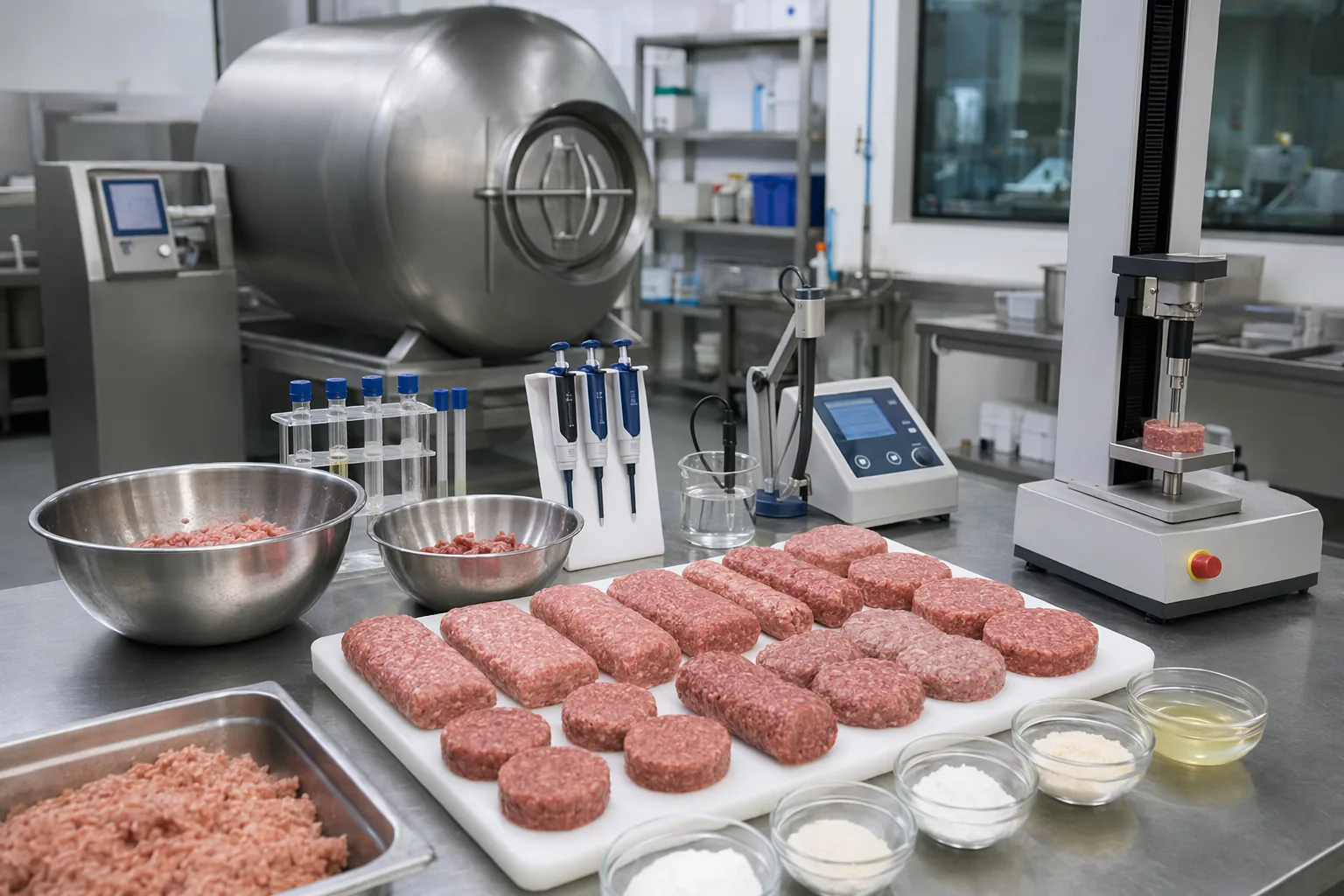
Build cleaner, more consistent meat tenderization and cold-set binding systems with industrial meat processing enzymes selected for your raw material, process, and finished-product targets.
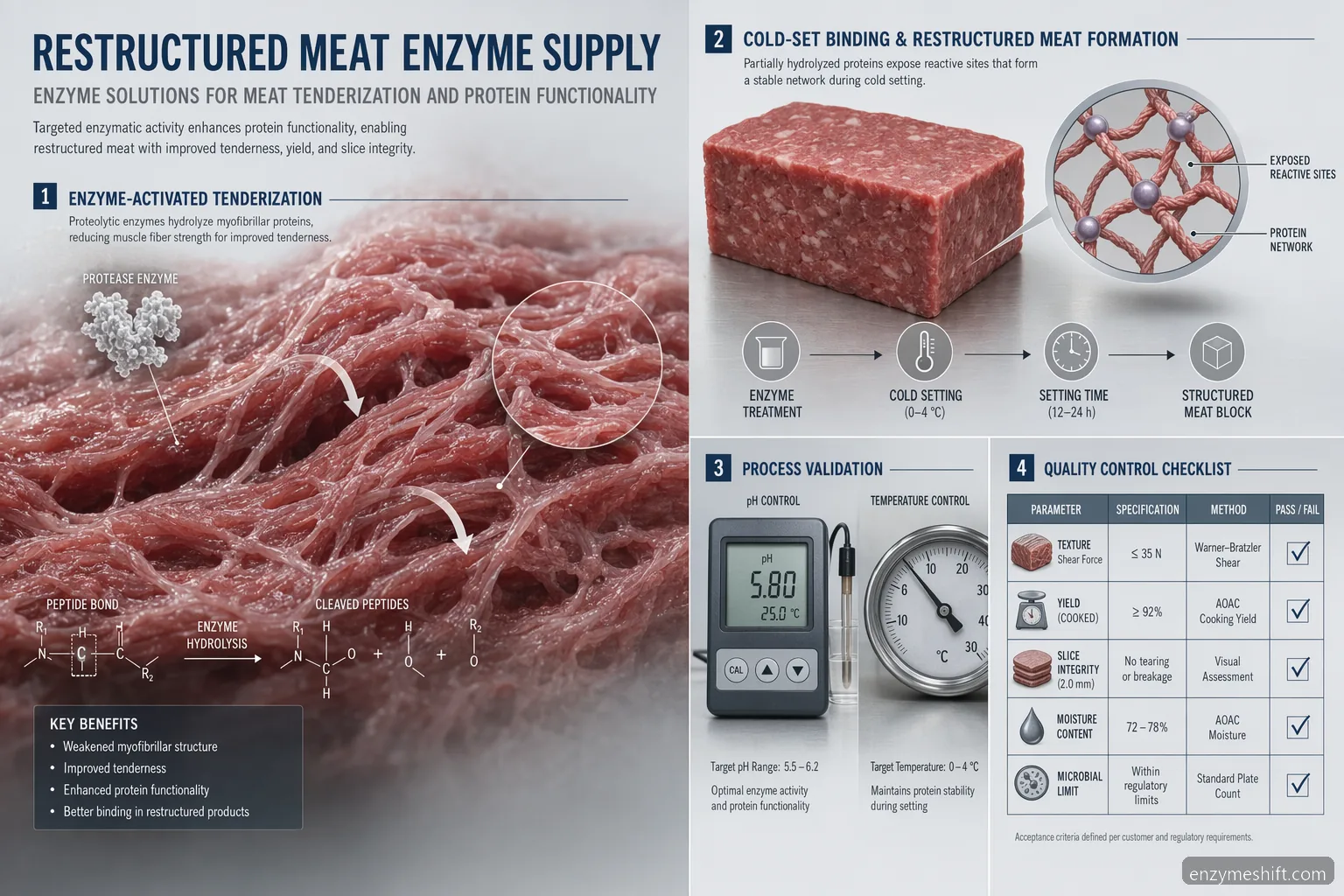
Formulating with meat processing enzymes
A restructured meat enzyme supplier for meat tenderization should help match enzyme function to the product brief, not simply quote an activity number. In meat tenderization, proteolytic enzymes such as plant or microbial proteases can modify myofibrillar and connective-tissue proteins to improve bite, while transglutaminase-based systems support binding in restructured meat, formed steaks, portioned trim, and sausage-style products. The formulation goal is to balance tenderness, binding strength, purge control, sliceability, and consumer-acceptable texture. Over-treatment can produce soft, mushy bite or weak structure, so enzyme choice, dose, contact time, and heat history must be controlled. For industrial restructured meat enzyme meat tenderization projects, the best starting point is a raw-material map: species, lean-to-fat ratio, salt level, phosphate use, injection or tumbling method, particle size, and whether the product is raw, par-cooked, cooked, frozen, or chilled.
Define target texture before selecting enzyme chemistry. • Separate tenderization objectives from binding objectives. • Screen enzymes on the actual plant raw material.
Typical process conditions to validate
Most meat systems operate near pH 5.5 to 6.8, and that range is usually suitable for initial enzyme screening, although exact performance depends on the enzyme source and the finished product. For protease tenderization, trial dosage bands often begin around 0.01% to 0.10% of meat weight, adjusted for activity, contact time, and raw-material toughness. For transglutaminase or cold-set binder systems, usage may be evaluated around 0.2% to 1.0% of a functional premix, depending on enzyme activity, carrier level, salt, protein substrate, and binding target. Keep meat cold during mixing, commonly 0 to 8°C, to protect food safety and control reaction rate. Some enzymes show stronger activity at warmer temperatures, such as 35 to 55°C, but any warm hold must be validated under the processor’s HACCP or food safety plan. Cooking should meet product safety requirements and can also reduce residual enzyme activity.
Initial pH screen: approximately 5.5 to 6.8. • Cold mixing and holding: commonly 0 to 8°C. • Pilot before scaling dosage or hold time.
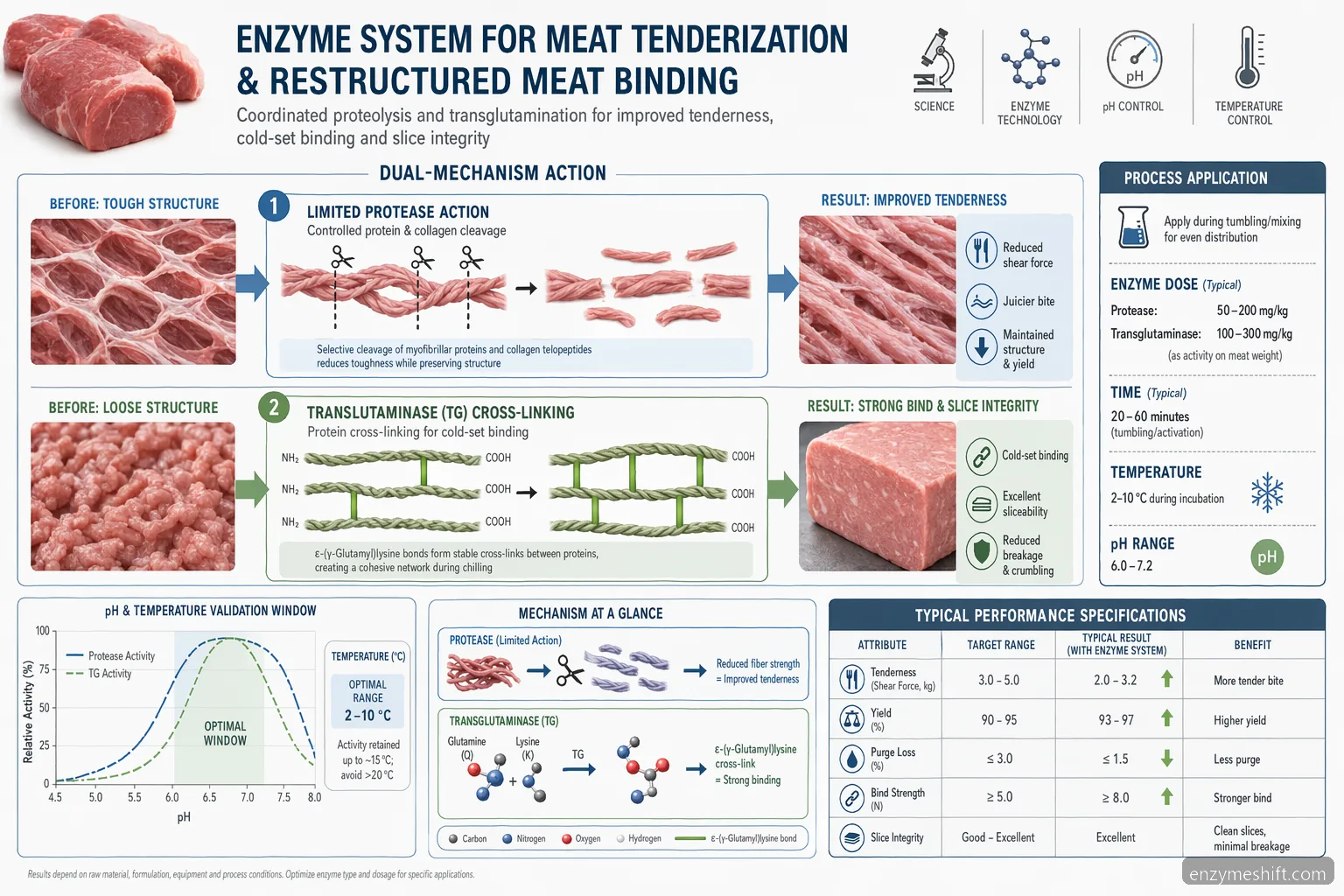
Applications in tenderized, restructured, and sausage products
A restructured meat enzyme supplier for restructured meat should understand how enzyme systems behave across comminuted, chunked, injected, tumbled, and formed products. In whole-muscle tenderization, the enzyme may be delivered by marinade, injection, vacuum tumbling, or surface application, with uniform distribution as a critical control point. In restructured meat, enzyme-assisted binding can help turn trim or portioned pieces into stable formats that maintain shape through chilling, freezing, slicing, and cooking. For sausage, a restructured meat enzyme supplier for sausage may support bind, bite, and water management, especially when salt reduction, lean formulation, or alternative protein inclusion changes texture. The same enzyme will not perform identically in every matrix. Fat level, salt, phosphates, starch, fiber, soy or dairy proteins, smoke schedule, and thermal profile can shift both tenderization rate and final gel or bond strength.
Use injection or tumbling trials to confirm distribution. • Check bind strength after chilling, freezing, and cooking. • Evaluate sausage bite, purge, and slice integrity.
Quality control and plant-scale validation
Before approving a meat tenderizer enzyme supplier for restructured meat or meat tenderization, build a validation plan that connects lab results to line performance. Useful QC checks include texture profile analysis, Warner-Bratzler shear force, sensory bite panel, bind strength, slice yield, purge, cook loss, moisture, protein, pH, water activity where relevant, and microbiological compliance. During scale-up, monitor enzyme dispersion, mixer load, vacuum level, brine pickup, tumble time, product temperature, hold time, and cook endpoint. Compare treated and untreated controls from the same raw-material lot. A successful pilot should show the desired texture or binding improvement without excessive softening, off-texture, increased purge, or processing bottlenecks. Cost-in-use should include enzyme dosage, carrier contribution, process time, yield change, rework reduction, labor impact, and any changes to chilling, freezing, or cooking throughput.
Run side-by-side controls from the same meat lot. • Measure yield and texture, not enzyme price alone. • Document line settings used in successful pilots.
Supplier qualification checklist
For a restructured meat enzyme supplier for meat tenderization, technical documentation is part of the product. Request a current Certificate of Analysis for each lot, a Technical Data Sheet with activity definition and recommended storage, and a Safety Data Sheet for handling. Ask how activity is measured, what carriers or processing aids are present, and whether the enzyme is suitable for the target country and food category. Supplier qualification should also review allergen statements, GMO or non-GMO positioning if required by your label program, microbiological specifications, heavy metal limits where applicable, shelf life, packaging, and cold-chain or dry-storage needs. Avoid relying on unsupported performance claims. The strongest supplier relationship includes application support, sample quantities for bench work, pilot-trial guidance, transparent change notification, and reliable documentation for purchasing, QA, regulatory, and plant operations.
Request COA, TDS, SDS, and activity method. • Confirm regulatory and label fit for the market. • Require pilot support and change notification.
Technical Buying Checklist
Buyer Questions
A meat tenderizer enzyme is usually selected for controlled protein breakdown that improves bite in tougher cuts or trimmings. A restructured meat enzyme is typically selected for protein cross-linking or binding, helping meat pieces hold together in formed products. Some formulations use both concepts, but the process must be carefully validated to avoid over-tenderization, weak bind, purge, or inconsistent texture.
Sometimes, but performance depends on particle size, salt, fat level, added proteins, moisture, casing, smoke schedule, and cook profile. A restructured meat enzyme supplier for sausage should test the specific sausage matrix rather than transferring dosage directly from a formed-steak trial. Evaluate bind, bite, purge, sliceability, and cook loss after chilling or freezing to confirm the system is commercially useful.
Choose a meat tenderizer enzyme supplier for meat tenderization by reviewing technical support, documentation, lot consistency, activity method, sample availability, and scale-up experience. Request COA, TDS, SDS, allergen statements, storage guidance, and regulatory suitability information. Strong suppliers also help design bench and pilot trials, interpret texture and yield data, and calculate cost-in-use for the final formulation.
The main risks are uneven distribution, excessive softening, weak texture, high purge, poor sliceability, and inconsistent results between raw-material lots. Temperature abuse during holds is also a food safety concern. Control these risks with cold processing, validated dosage, defined contact time, side-by-side controls, texture testing, cook-loss measurement, microbiological checks, and clear operator instructions for mixing, tumbling, holding, and cooking.
Related Search Themes
restructured meat enzyme supplier for sausage, restructured meat enzyme supplier for restructured meat, restructured meat enzyme for meat tenderization, meat tenderizer enzyme supplier for restructured meat, meat tenderizer enzyme supplier for meat tenderization, industrial restructured meat enzyme meat tenderization
Meat Processing Enzymes for Research & Industry
Need Meat Processing Enzymes for your lab or production process?
ISO 9001 certified · Food-grade & research-grade · Ships to 80+ countries
Frequently Asked Questions
What is the difference between a meat tenderizer enzyme and a restructured meat enzyme?
A meat tenderizer enzyme is usually selected for controlled protein breakdown that improves bite in tougher cuts or trimmings. A restructured meat enzyme is typically selected for protein cross-linking or binding, helping meat pieces hold together in formed products. Some formulations use both concepts, but the process must be carefully validated to avoid over-tenderization, weak bind, purge, or inconsistent texture.
Can the same enzyme system be used for sausage and restructured meat?
Sometimes, but performance depends on particle size, salt, fat level, added proteins, moisture, casing, smoke schedule, and cook profile. A restructured meat enzyme supplier for sausage should test the specific sausage matrix rather than transferring dosage directly from a formed-steak trial. Evaluate bind, bite, purge, sliceability, and cook loss after chilling or freezing to confirm the system is commercially useful.
How should an industrial processor choose a supplier?
Choose a meat tenderizer enzyme supplier for meat tenderization by reviewing technical support, documentation, lot consistency, activity method, sample availability, and scale-up experience. Request COA, TDS, SDS, allergen statements, storage guidance, and regulatory suitability information. Strong suppliers also help design bench and pilot trials, interpret texture and yield data, and calculate cost-in-use for the final formulation.
What are the main risks when using enzymes in meat tenderization?
The main risks are uneven distribution, excessive softening, weak texture, high purge, poor sliceability, and inconsistent results between raw-material lots. Temperature abuse during holds is also a food safety concern. Control these risks with cold processing, validated dosage, defined contact time, side-by-side controls, texture testing, cook-loss measurement, microbiological checks, and clear operator instructions for mixing, tumbling, holding, and cooking.
Related: Meat Processing Enzymes for Controlled Processing
Turn This Guide Into a Supplier Brief Contact EnzymeShift to request meat processing enzyme samples, documentation, and pilot-trial support for your tenderization or restructuring formulation. See our application page for Meat Processing Enzymes for Controlled Processing at /applications/meat-processing-enzymes/ for specs, MOQ, and a free 50 g sample.
Contact Us to Contribute