Meat Tenderizer Enzyme for Meat Tenderization: Dosage, pH, and Temperature Guidance
Troubleshoot meat tenderizer enzyme for meat tenderization: dosage, pH, temperature, QC, COA/TDS/SDS, pilot trials, and supplier qualification.
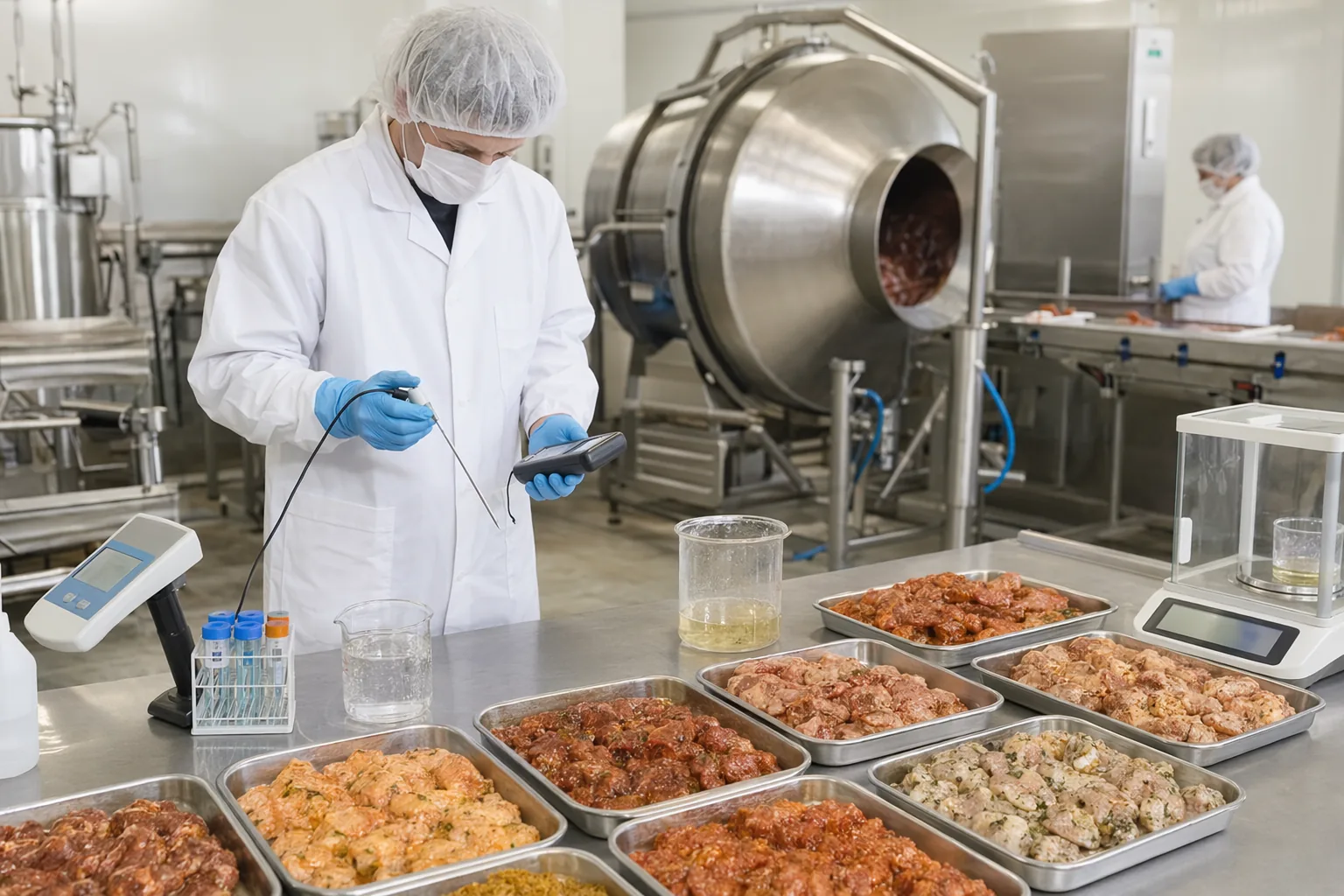
Industrial guidance for processors troubleshooting texture, yield, and consistency when selecting meat processing enzymes for tenderization, restructured meat, and sausage systems.
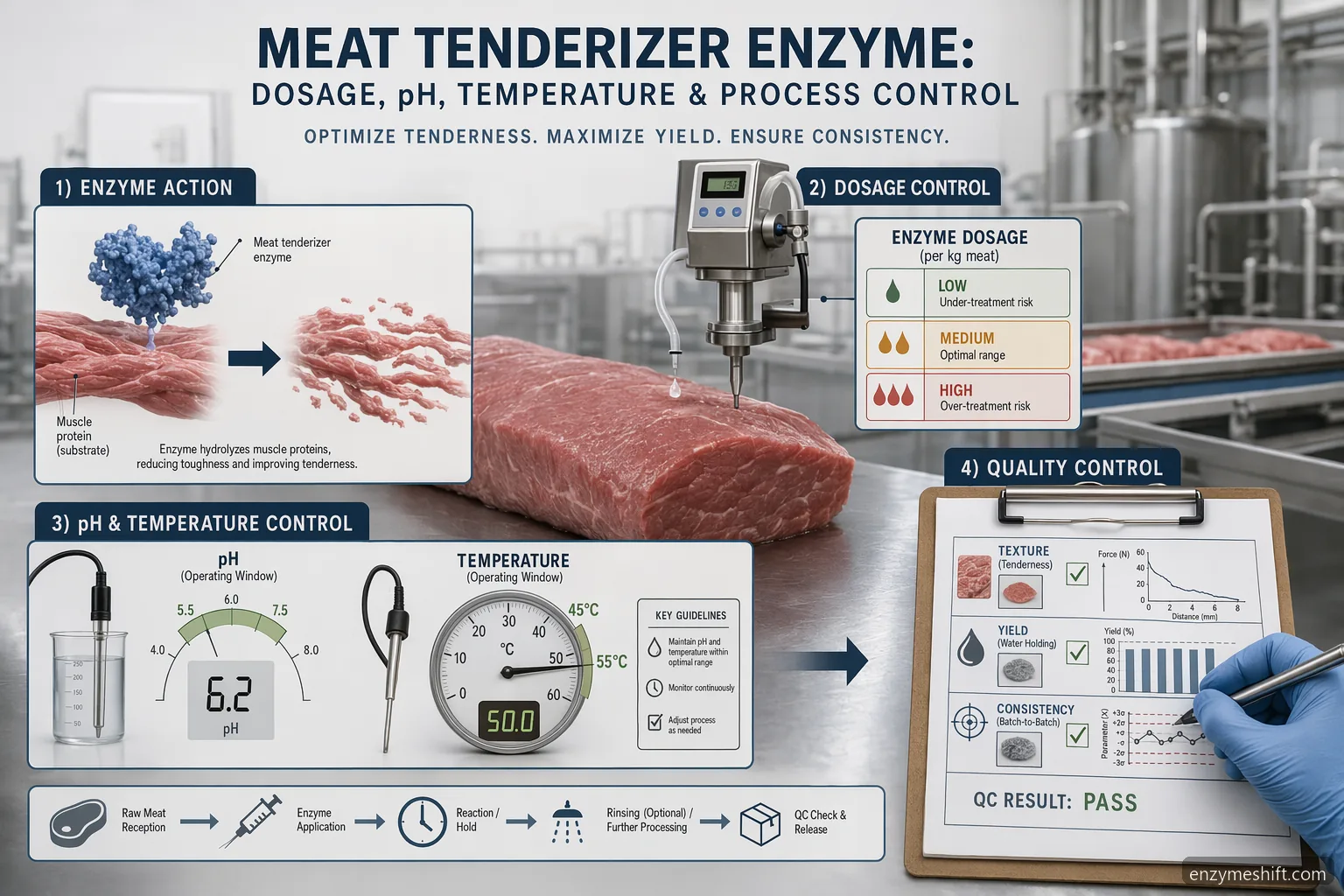
Why Tenderization Programs Drift in Industrial Meat Plants
A meat tenderizer enzyme for meat tenderization is usually a protease system selected to partially hydrolyze muscle proteins and connective tissue, improving bite without creating mushy texture. In industrial production, drift often appears when raw material age, animal source, injection pickup, tumble time, brine pH, salt level, or thermal profile changes. Papain, bromelain, ficin, and microbial proteases can all behave differently, and activity units are not interchangeable across suppliers. For B2B buyers, the practical question is not only price per kilogram but whether the enzyme delivers repeatable texture at the lowest validated cost-in-use. A qualified meat tenderizer enzyme supplier for meat tenderization should help define the enzyme type, activity assay, recommended dosage range, and inactivation conditions. Troubleshooting should begin with a small factorial pilot: dosage, pH, temperature, and hold time, followed by plant-scale confirmation under normal line variability.
Common symptoms: soft edges, dry bite, excessive purge, weak slice integrity, or inconsistent tenderness. • Do not compare enzyme products only by inclusion rate; compare activity units and process response. • Validate under the same brine, salt, phosphate, and cooking conditions used in production.
Dosage Bands for Whole-Muscle Meat Tenderization
For an industrial meat tenderizer enzyme meat tenderization program, dosage should be expressed against meat weight, brine weight, or finished batch weight with the supplier activity clearly stated. As a starting screen, many protease preparations are tested around 0.005% to 0.10% of meat weight, or approximately 50 to 1000 ppm of commercial enzyme preparation, depending on declared activity and contact time. Lower dosages are typically used in injection or vacuum tumbling where distribution is efficient; higher trial points may be needed for short contact times or tougher raw material. Avoid jumping directly to high dosages because over-tenderization can reduce sliceability, increase purge, and create pasty texture after cook. Build a dosage ladder with at least a control, low, mid, and high treatment. Record pickup, brine retention, internal temperature, residence time, and final yield so the purchasing team can calculate cost-in-use rather than ingredient cost alone.
Suggested pilot ladder: 0%, 0.005%, 0.02%, 0.05%, and 0.10% of meat weight, adjusted to activity. • Use duplicate or triplicate batches when raw material variability is high. • Stop dosage escalation when tenderness improves but purge, slicing, or yield begins to fail.
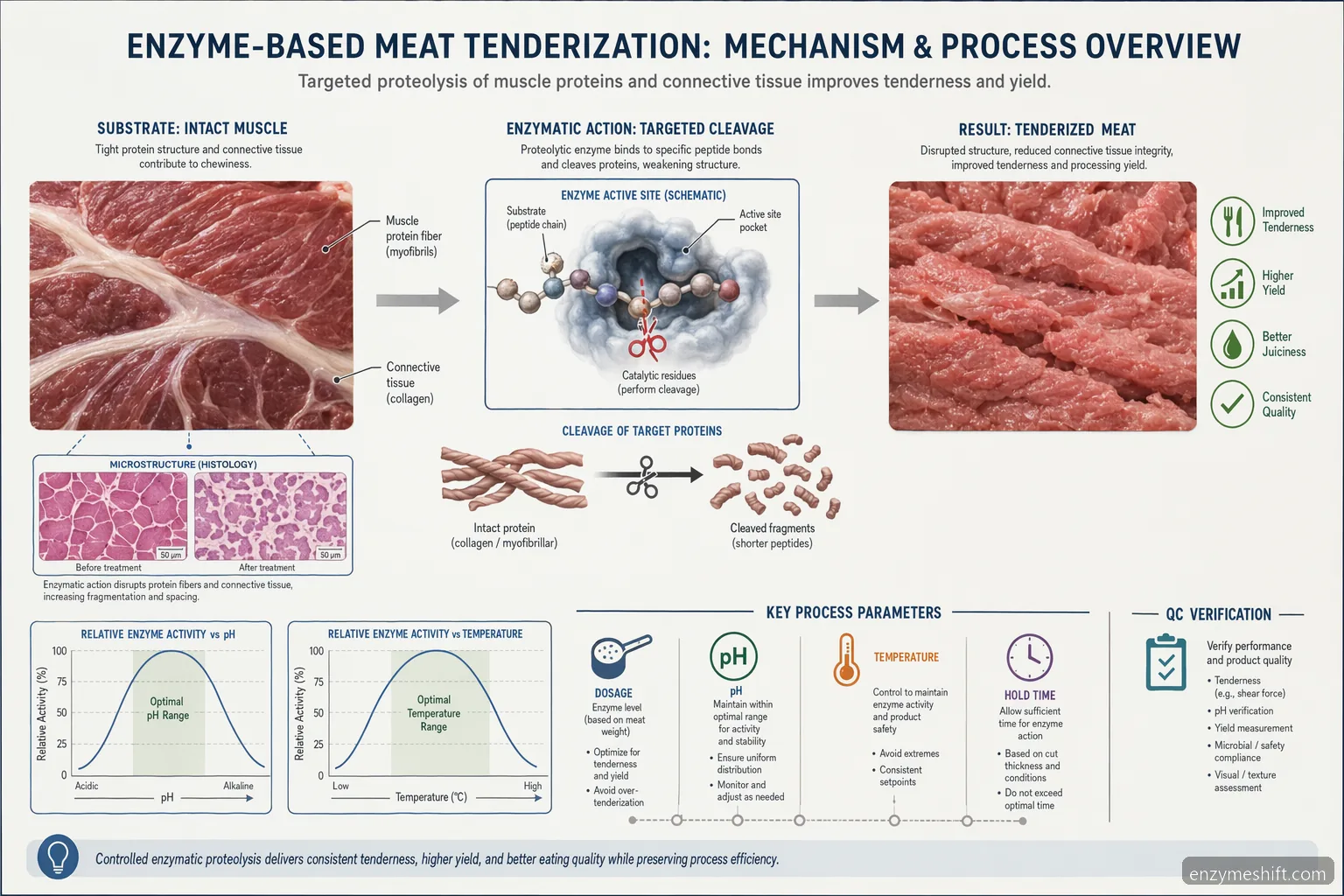
pH, Temperature, and Hold-Time Troubleshooting
Protease activity is strongly affected by pH and temperature, so the same meat tenderizer enzyme for meat tenderization can perform very differently across marinated cuts, cooked hams, beef pieces, or poultry systems. Many plant trials begin around pH 5.5 to 7.0 for papain or bromelain-type systems, while selected microbial proteases may tolerate broader ranges such as pH 5.5 to 8.0; the product TDS should be treated as the controlling reference. Cold processing at 0 to 5°C slows activity and improves control, but still allows gradual hydrolysis during long holds. Warm pre-processing, for example 35 to 55°C where permitted by food safety controls, can accelerate activity and raise the risk of over-softening. Cooking normally reduces protease activity when the validated core temperature is reached, but inactivation depends on enzyme type, time, product geometry, and matrix composition.
Check brine pH before enzyme addition and after mixing with meat. • Map actual meat core temperature, not only room or water temperature. • Shorten hold time before increasing temperature in troubleshooting trials. • Confirm inactivation through finished-product texture stability during shelf-life testing.
Restructured Meat, Sausage, and Cold-Set Binder Decisions
Not every restructured meat enzyme for meat tenderization is a protease. For restructured meat, cold-set binder applications often use transglutaminase systems that crosslink proteins and improve binding, while proteases tenderize by hydrolysis. Using the wrong class can create the opposite effect: too much protease may weaken bind, while too little binder may lead to cracks, purge, or poor slice integrity. A restructured meat enzyme supplier for meat tenderization should clarify whether the goal is tender bite, particle binding, sliceability, or yield retention. In sausage, a meat tenderizer enzyme supplier for sausage may recommend very low protease trials where the target is softer bite, but the formulation must also protect emulsion stability, fat retention, and casing performance. For restructured meat, enzyme selection should be tested with salt level, phosphate policy, particle size, vacuum, forming pressure, and chilled set time.
Protease: used to modify tenderness and bite. • Transglutaminase-type binder: used to improve structure and particle adhesion. • Sausage trials must monitor emulsion break, fat-out, purge, and casing bite. • Restructured meat trials should include slicing, bending, and cook-yield checks.
Supplier Qualification, QC Checks, and Cost-in-Use
A reliable meat tenderizer enzyme supplier for restructured meat, sausage, or whole-muscle tenderization should provide a current COA, TDS, SDS, lot traceability, storage guidance, declared activity method, recommended process conditions, and regulatory documentation appropriate to the destination market. The COA should match the lot delivered and include identity, activity, microbiological limits where relevant, and shelf-life information. The TDS should define pH range, temperature range, dosage guidance, solubility or dispersion instructions, and any carriers or processing aids disclosed as required. In pilot validation, measure objective texture such as Warner-Bratzler shear, texture profile analysis, slice integrity, purge, cook yield, color, and sensory bite. Purchasing should compare suppliers by cost per validated batch outcome, not only enzyme price. A slightly higher-priced enzyme may be cheaper if it reduces dosage, scrap, rework, or texture complaints under normal plant variability.
Request COA, TDS, SDS, allergen information, traceability, and activity assay description. • Run pilot validation before plant-wide conversion. • Calculate cost-in-use from dosage, yield, defects, rework, and labor impact. • Approve suppliers through documented specification and incoming QC checks.
Technical Buying Checklist
Buyer Questions
The best choice depends on raw material, target bite, pH, temperature, hold time, and cooking profile. Papain and bromelain-type systems are common, while microbial proteases may be selected for specific pH or processing needs. A supplier should provide activity data and TDS guidance, but the final decision should be made through pilot trials measuring tenderness, purge, yield, and sliceability.
A practical pilot range is often 0.005% to 0.10% of meat weight, but activity units vary widely by product and supplier. Start with a control plus low, medium, and high dosages under normal plant conditions. Validate with objective texture tests, yield, purge, and sensory review before setting a production specification. Avoid over-dosing because proteases can create mushy texture and weak slices.
Sometimes, but the performance target is different. A meat tenderizer enzyme for sausage may soften bite, while a restructured meat enzyme for meat tenderization may need to balance tenderness with binding. Cold-set binder systems, often transglutaminase-based, are used for adhesion rather than proteolysis. Test each application separately because salt, fat, particle size, vacuum, and heat treatment change the result.
A qualified supplier should provide a lot-specific COA, TDS, SDS, activity method, traceability, shelf-life and storage guidance, and regulatory statements suitable for the destination market. The TDS should include dosage, pH, temperature, and handling guidance. Buyers should also ask for pilot support, change-control communication, and enough technical data to calculate cost-in-use and set incoming quality checks.
Excessive softness usually indicates over-dosage, long chilled hold time, warm temperature exposure, high enzyme activity, incomplete inactivation, or raw material variability. Review the time-temperature history from enzyme addition through cooking, then compare texture immediately after cook and during shelf-life. Reduce dosage, shorten hold time, lower processing temperature, or select a more controllable enzyme system after a structured pilot trial.
Related Search Themes
meat tenderizer enzyme supplier for meat tenderization, industrial meat tenderizer enzyme meat tenderization, restructured meat enzyme supplier for meat tenderization, restructured meat enzyme for meat tenderization, meat tenderizer enzyme supplier for sausage, meat tenderizer enzyme supplier for restructured meat
Meat Processing Enzymes for Research & Industry
Need Meat Processing Enzymes for your lab or production process?
ISO 9001 certified · Food-grade & research-grade · Ships to 80+ countries
Frequently Asked Questions
What is the best meat tenderizer enzyme for meat tenderization?
The best choice depends on raw material, target bite, pH, temperature, hold time, and cooking profile. Papain and bromelain-type systems are common, while microbial proteases may be selected for specific pH or processing needs. A supplier should provide activity data and TDS guidance, but the final decision should be made through pilot trials measuring tenderness, purge, yield, and sliceability.
How much meat tenderizer enzyme should an industrial plant use?
A practical pilot range is often 0.005% to 0.10% of meat weight, but activity units vary widely by product and supplier. Start with a control plus low, medium, and high dosages under normal plant conditions. Validate with objective texture tests, yield, purge, and sensory review before setting a production specification. Avoid over-dosing because proteases can create mushy texture and weak slices.
Can the same enzyme be used for sausage and restructured meat?
Sometimes, but the performance target is different. A meat tenderizer enzyme for sausage may soften bite, while a restructured meat enzyme for meat tenderization may need to balance tenderness with binding. Cold-set binder systems, often transglutaminase-based, are used for adhesion rather than proteolysis. Test each application separately because salt, fat, particle size, vacuum, and heat treatment change the result.
What documents should a meat tenderizer enzyme supplier provide?
A qualified supplier should provide a lot-specific COA, TDS, SDS, activity method, traceability, shelf-life and storage guidance, and regulatory statements suitable for the destination market. The TDS should include dosage, pH, temperature, and handling guidance. Buyers should also ask for pilot support, change-control communication, and enough technical data to calculate cost-in-use and set incoming quality checks.
Why did our tenderized meat become too soft after storage?
Excessive softness usually indicates over-dosage, long chilled hold time, warm temperature exposure, high enzyme activity, incomplete inactivation, or raw material variability. Review the time-temperature history from enzyme addition through cooking, then compare texture immediately after cook and during shelf-life. Reduce dosage, shorten hold time, lower processing temperature, or select a more controllable enzyme system after a structured pilot trial.
Related: Meat Processing Enzymes for Controlled Processing
Turn This Guide Into a Supplier Brief Request a technical review for enzyme selection, pilot dosage design, COA/TDS/SDS evaluation, and cost-in-use modeling for your meat tenderization line. See our application page for Meat Processing Enzymes for Controlled Processing at /applications/meat-processing-enzymes/ for specs, MOQ, and a free 50 g sample.
Contact Us to Contribute