Meat Tenderizer Enzyme Supplier for Meat Tenderization
B2B guide to sourcing meat processing enzymes for tenderization, restructured meat, and sausage with specs, QC, dosage, and validation tips.
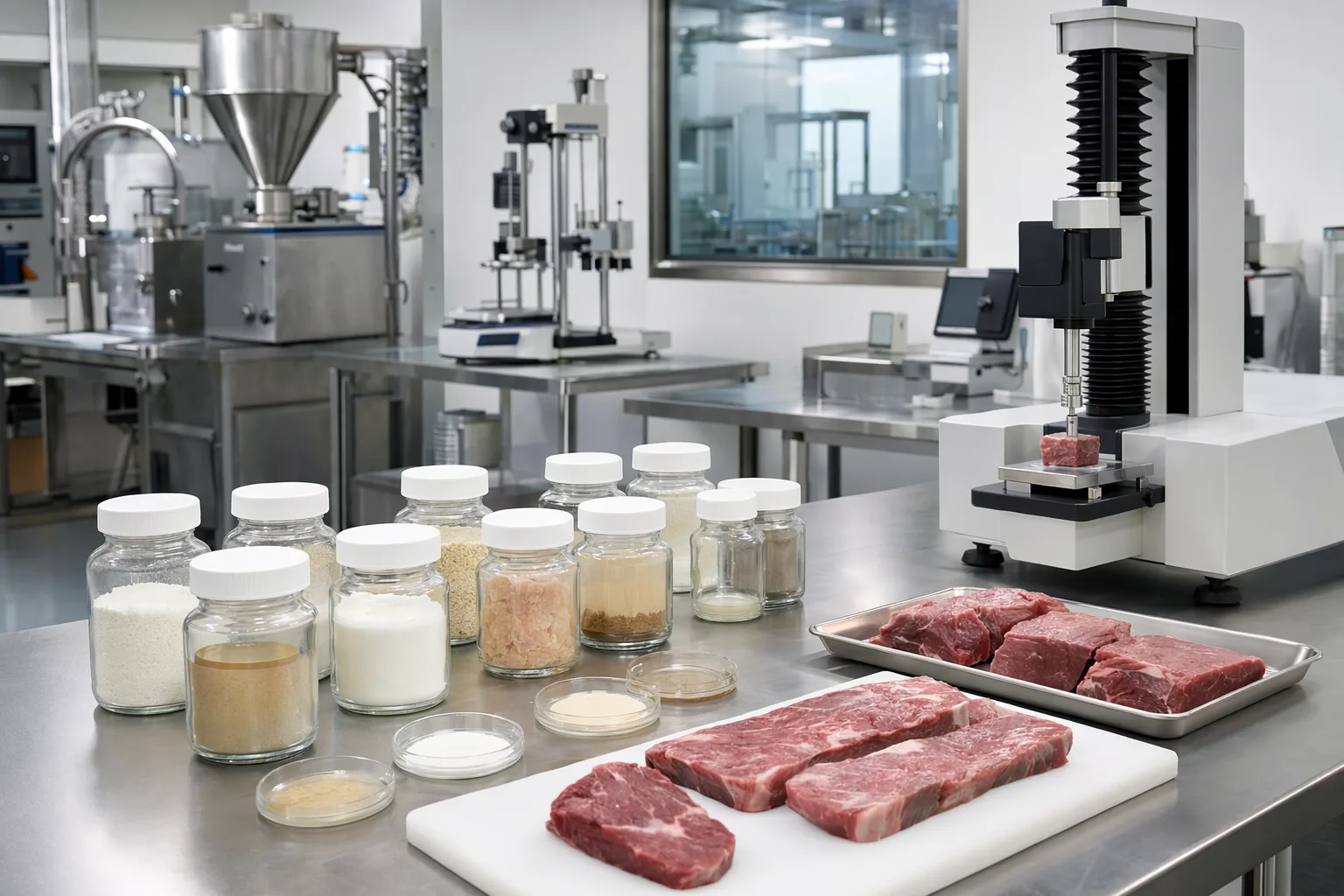
Select meat processing enzymes with confidence by matching enzyme type, process conditions, quality documents, and pilot results to your meat tenderization, restructured meat, and sausage goals.
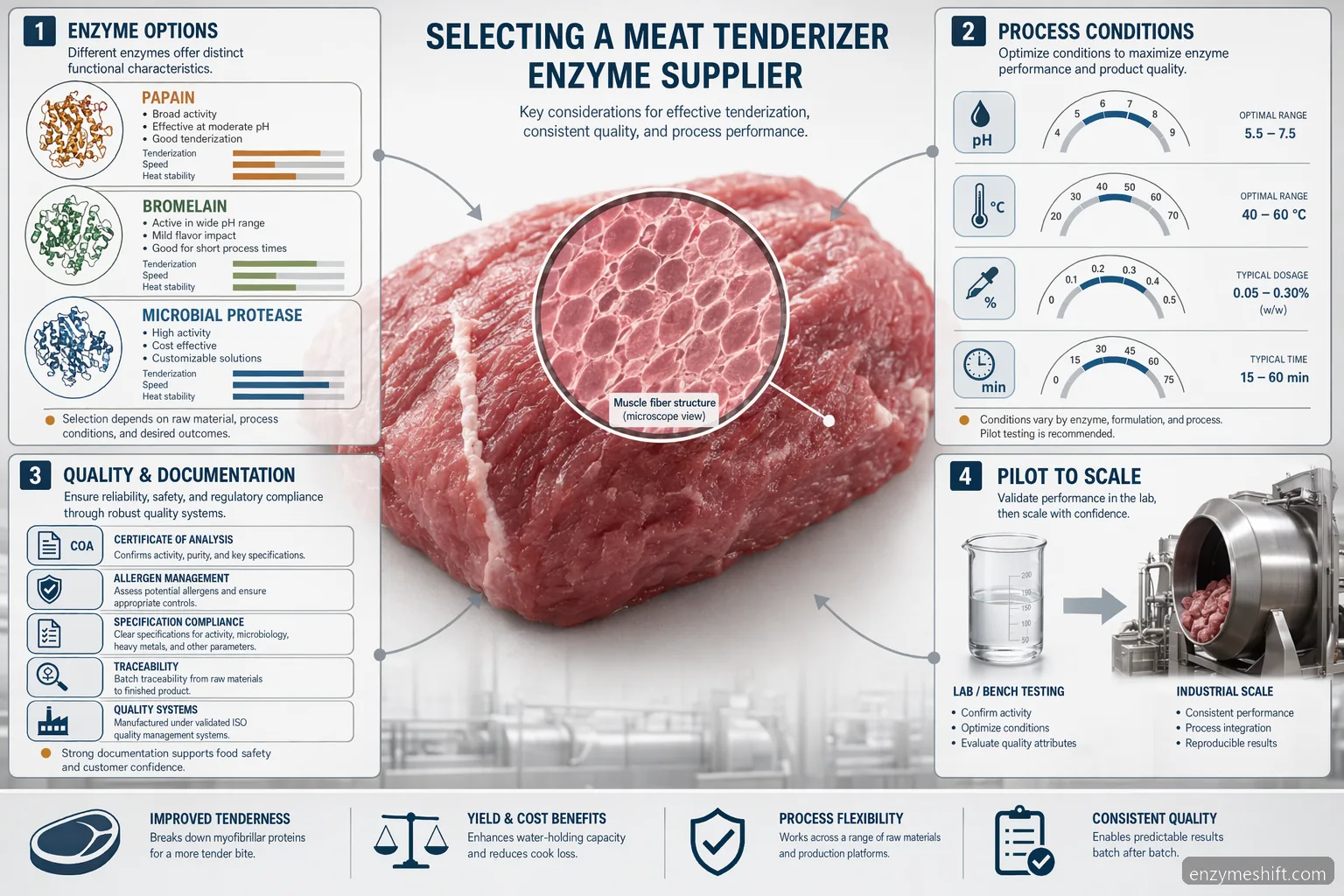
What Buyers Need from Meat Processing Enzymes
A meat tenderizer enzyme supplier for meat tenderization should help processors create repeatable texture improvements without excessive softening, purge, or yield loss. In industrial use, enzymes are selected for the substrate, process format, and finished product target, not as generic additives. Proteases such as papain, bromelain, ficin, and selected microbial proteases hydrolyze muscle proteins and connective tissue to improve bite and reduce toughness. Transglutaminase is used differently: it links proteins and is often specified when a plant needs a restructured meat enzyme supplier for meat tenderization systems that also require binding, forming, or portion control. Buyer intent should focus on documented activity, recommended conditions, lot consistency, and application support. The best sourcing process compares enzyme performance in your real brine, marinade, tumbling, injection, forming, cooking, chilling, and packaging workflow.
Define the target: tenderness, binding, sliceability, yield, or bite. • Confirm whether you need proteolysis, protein cross-linking, or both. • Evaluate performance on the actual meat species and formulation.
Enzyme Options for Tenderization, Restructuring, and Sausage
For meat tenderization, proteases are typically applied through marinade, injection, tumble brine, surface treatment, or dry seasoning systems. Papain and bromelain can act strongly and may require careful control to avoid a mushy texture, especially in thin cuts or extended hold times. Microbial proteases can offer different activity profiles and may be easier to tune for specific processing windows. For restructured meat, transglutaminase is the common cold-set binder because it promotes protein cross-linking during refrigerated holding and can improve binding before cooking. A meat tenderizer enzyme supplier for sausage may recommend protease only when the goal is softer bite or improved raw material utilization; too much activity can weaken particle definition. In emulsified or coarse-ground sausage, enzyme use must be tested against salt level, phosphate use where permitted, fat content, mixing energy, and cook schedule.
Tenderization: protease selection and controlled reaction time are critical. • Restructured meat: transglutaminase supports binding and form stability. • Sausage: validate texture, fat separation, and bite before scale-up.
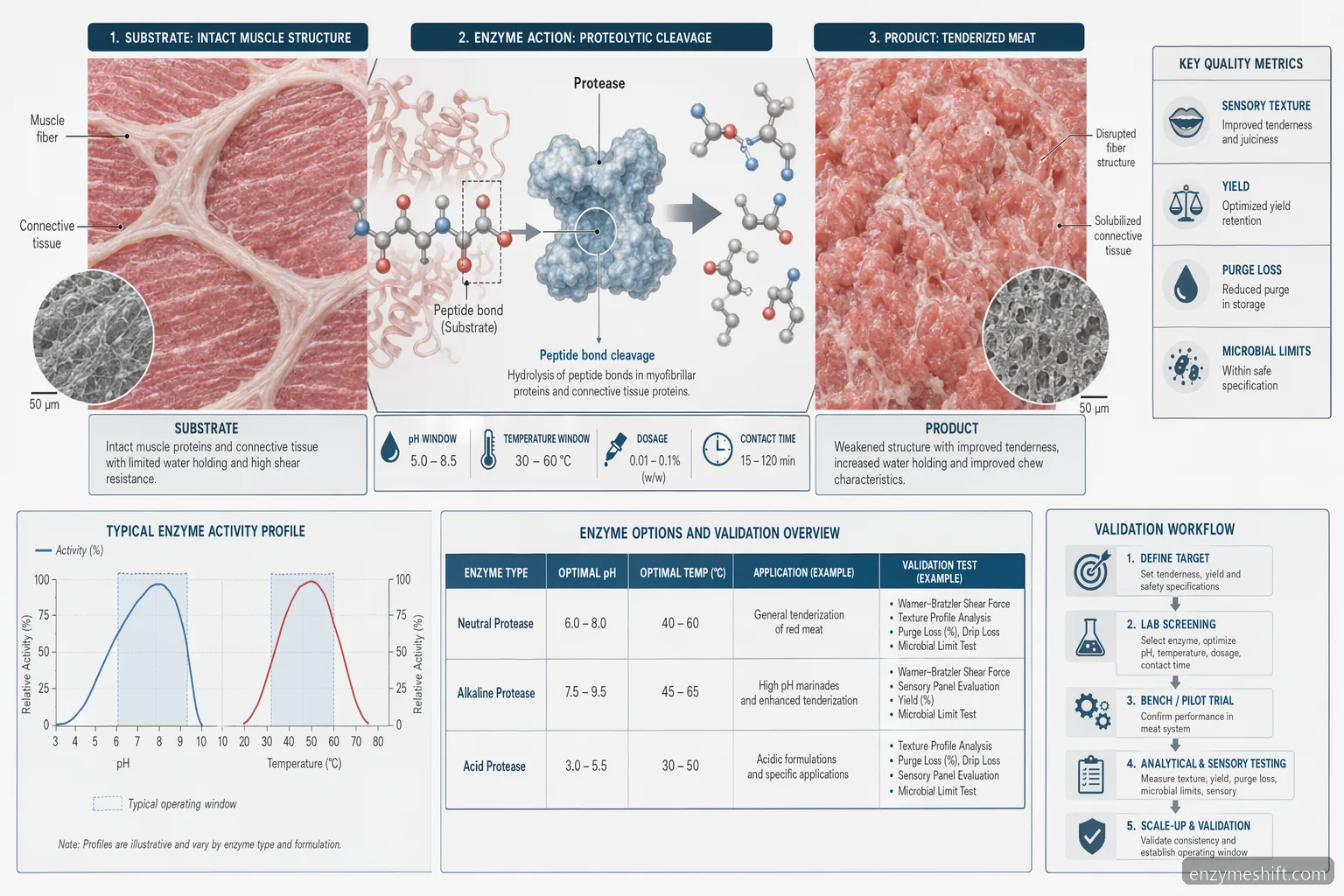
Practical Process Conditions to Validate
A reliable meat tenderizer enzyme for meat tenderization should be evaluated under plant-realistic conditions. Many meat protease applications operate near meat pH, commonly around pH 5.5 to 7.0, but each enzyme has its own activity curve. Temperature is equally important: refrigerated tumbling may slow activity, while warm marinade steps can accelerate tenderization. Some proteases show strong activity around 45 to 60°C, but that does not mean warm processing is always appropriate for food safety or product quality. Dosage often begins in pilot trials around 0.02% to 0.30% of commercial enzyme preparation, depending on activity, substrate, and contact time. Transglutaminase systems for restructured meat are often tested at refrigerated temperatures with several hours of set time before cooking. Always confirm the supplier’s TDS and run sensory and instrumental texture checks before setting a plant dosage.
Validate pH, temperature, dosage, and contact time together. • Use cooking or thermal processing to stop enzyme activity where applicable. • Run trials at minimum, target, and maximum expected plant conditions.
Quality Control Checks for Production Approval
Industrial enzyme approval should combine supplier documentation with in-house process data. For tenderized whole muscle, useful QC checks include raw pH, brine pickup, purge, cook yield, slice integrity, sensory bite, and instrumental shear force such as Warner-Bratzler or comparable texture methods. For restructured meat, add bind strength, seam visibility, shape retention, freeze-thaw stability, and cooking loss. For sausage, monitor particle definition, emulsion stability, fat-out, texture profile, and casing performance. A restructured meat enzyme supplier for sausage should be able to explain how enzyme activity interacts with salt, protein extraction, mixing, and chilled holding. Lot-to-lot checks should compare certificate activity with a small application assay, not only paperwork. Enzyme overuse can reduce firmness, increase purge, or alter bite, so acceptance limits should be written before commercial batches begin.
Set objective targets for tenderness, yield, purge, and bind. • Compare enzyme-treated samples with untreated controls. • Track lot number, dosage, mix time, hold time, and cook profile.
Supplier Qualification and Required Documents
Before buying from a meat tenderizer enzyme supplier for restructured meat or tenderization, request the core technical and safety package. A COA should identify the product, lot, activity or potency method where applicable, and release parameters. A TDS should state enzyme source, application guidance, typical pH and temperature range, dosage starting points, solubility or dispersion guidance, storage, shelf life, and handling notes. An SDS is required for safe industrial handling, especially powders that may create dust exposure. Buyers should also request allergen information, ingredient composition, carrier details, country of origin, GMO status if relevant to the market, and regulatory suitability for the intended sales region. Strong suppliers support pilot validation, provide realistic cost-in-use calculations, and help troubleshoot overdosing, under-tenderization, weak bind, or inconsistent results.
Request COA, TDS, SDS, allergen statement, and traceability data. • Confirm food-use suitability for your target markets. • Assess technical support, lead time, packaging, and shelf life.
Cost-in-Use and Scale-Up Strategy
The lowest price per kilogram is not always the lowest cost-in-use. Enzyme activity, required dosage, yield impact, scrap reduction, labor savings, processing time, and batch consistency all influence the real economics. A concentrated enzyme may cost more per unit but use less per batch; a cheaper product may require higher dosage or produce inconsistent texture. During scale-up, compare supplier samples under equal activity-normalized or application-normalized conditions. Run pilot batches through the same injection, tumbling, mixing, forming, chilling, cooking, and packaging steps used in production. For a restructured meat enzyme supplier for restructured meat, include forming pressure, set time, cook yield, slicing performance, and cold-chain conditions in the trial. For a meat tenderizer enzyme supplier for sausage, include grind size, mixing time, salt extraction, fat stability, and final bite.
Calculate cost per finished kilogram, not only enzyme price. • Include yield, rework, labor, and quality variation in the model. • Scale from bench to pilot to production before approval.
Technical Buying Checklist
Buyer Questions
Choose a supplier that provides documented enzyme activity, application guidance, COA, TDS, SDS, and pilot support. Ask for recommended pH, temperature, dosage, and contact time for your meat species and process. Shortlist suppliers by lot consistency, regulatory fit, technical responsiveness, and cost-in-use. Final approval should come from plant trials measuring tenderness, purge, cook yield, flavor, and texture stability.
A meat tenderizer enzyme is usually a protease that breaks down proteins to soften meat texture. A restructured meat enzyme is commonly transglutaminase, which helps cross-link proteins to bind pieces together and support shape retention. Some applications may use both concepts, but they must be balanced carefully because excessive protease activity can weaken bind and reduce sliceability.
Yes, but sausage applications need careful validation. A meat tenderizer enzyme supplier for sausage may help adjust bite or improve use of tougher raw materials, while transglutaminase may support binding in certain formed products. Trials should check grind definition, mixing time, salt extraction, fat-out, cook yield, casing performance, and final texture. Overdosing can create soft, pasty, or unstable products.
There is no universal dosage because commercial enzyme preparations differ in activity and carriers. Many pilot programs start around 0.02% to 0.30% of the enzyme preparation, then adjust based on meat type, pH, temperature, contact time, and desired tenderness. Always follow the supplier TDS as a starting point and confirm with controlled trials against untreated product.
A qualified supplier should provide a COA for each lot, a TDS with application and storage guidance, and an SDS for safe handling. Buyers should also request allergen information, ingredient composition, carrier details, origin, shelf life, traceability, and regulatory suitability for intended markets. These documents should be reviewed together with pilot results before commercial approval.
Related Search Themes
restructured meat enzyme supplier for meat tenderization, meat tenderizer enzyme supplier for sausage, meat tenderizer enzyme supplier for restructured meat, meat tenderizer enzyme for meat tenderization, industrial meat tenderizer enzyme meat tenderization, restructured meat enzyme supplier for sausage
Meat Processing Enzymes for Research & Industry
Need Meat Processing Enzymes for your lab or production process?
ISO 9001 certified · Food-grade & research-grade · Ships to 80+ countries
Frequently Asked Questions
How do I choose a meat tenderizer enzyme supplier for meat tenderization?
Choose a supplier that provides documented enzyme activity, application guidance, COA, TDS, SDS, and pilot support. Ask for recommended pH, temperature, dosage, and contact time for your meat species and process. Shortlist suppliers by lot consistency, regulatory fit, technical responsiveness, and cost-in-use. Final approval should come from plant trials measuring tenderness, purge, cook yield, flavor, and texture stability.
What is the difference between a meat tenderizer enzyme and a restructured meat enzyme?
A meat tenderizer enzyme is usually a protease that breaks down proteins to soften meat texture. A restructured meat enzyme is commonly transglutaminase, which helps cross-link proteins to bind pieces together and support shape retention. Some applications may use both concepts, but they must be balanced carefully because excessive protease activity can weaken bind and reduce sliceability.
Can enzymes be used in sausage manufacturing?
Yes, but sausage applications need careful validation. A meat tenderizer enzyme supplier for sausage may help adjust bite or improve use of tougher raw materials, while transglutaminase may support binding in certain formed products. Trials should check grind definition, mixing time, salt extraction, fat-out, cook yield, casing performance, and final texture. Overdosing can create soft, pasty, or unstable products.
What dosage should we use for industrial meat tenderization?
There is no universal dosage because commercial enzyme preparations differ in activity and carriers. Many pilot programs start around 0.02% to 0.30% of the enzyme preparation, then adjust based on meat type, pH, temperature, contact time, and desired tenderness. Always follow the supplier TDS as a starting point and confirm with controlled trials against untreated product.
What documents should a qualified enzyme supplier provide?
A qualified supplier should provide a COA for each lot, a TDS with application and storage guidance, and an SDS for safe handling. Buyers should also request allergen information, ingredient composition, carrier details, origin, shelf life, traceability, and regulatory suitability for intended markets. These documents should be reviewed together with pilot results before commercial approval.
Related: Meat Processing Enzymes for Controlled Processing
Turn This Guide Into a Supplier Brief Contact EnzymeShift to discuss pilot samples, specifications, and cost-in-use for meat tenderization enzymes. See our application page for Meat Processing Enzymes for Controlled Processing at /applications/meat-processing-enzymes/ for specs, MOQ, and a free 50 g sample.
Contact Us to Contribute