Restructured Meat Enzyme for Meat Tenderization: Specification Checklist
Compare meat processing enzyme specs for tenderization, restructured meat, and sausage. Review dosage, pH, QC, documents, and supplier checks.
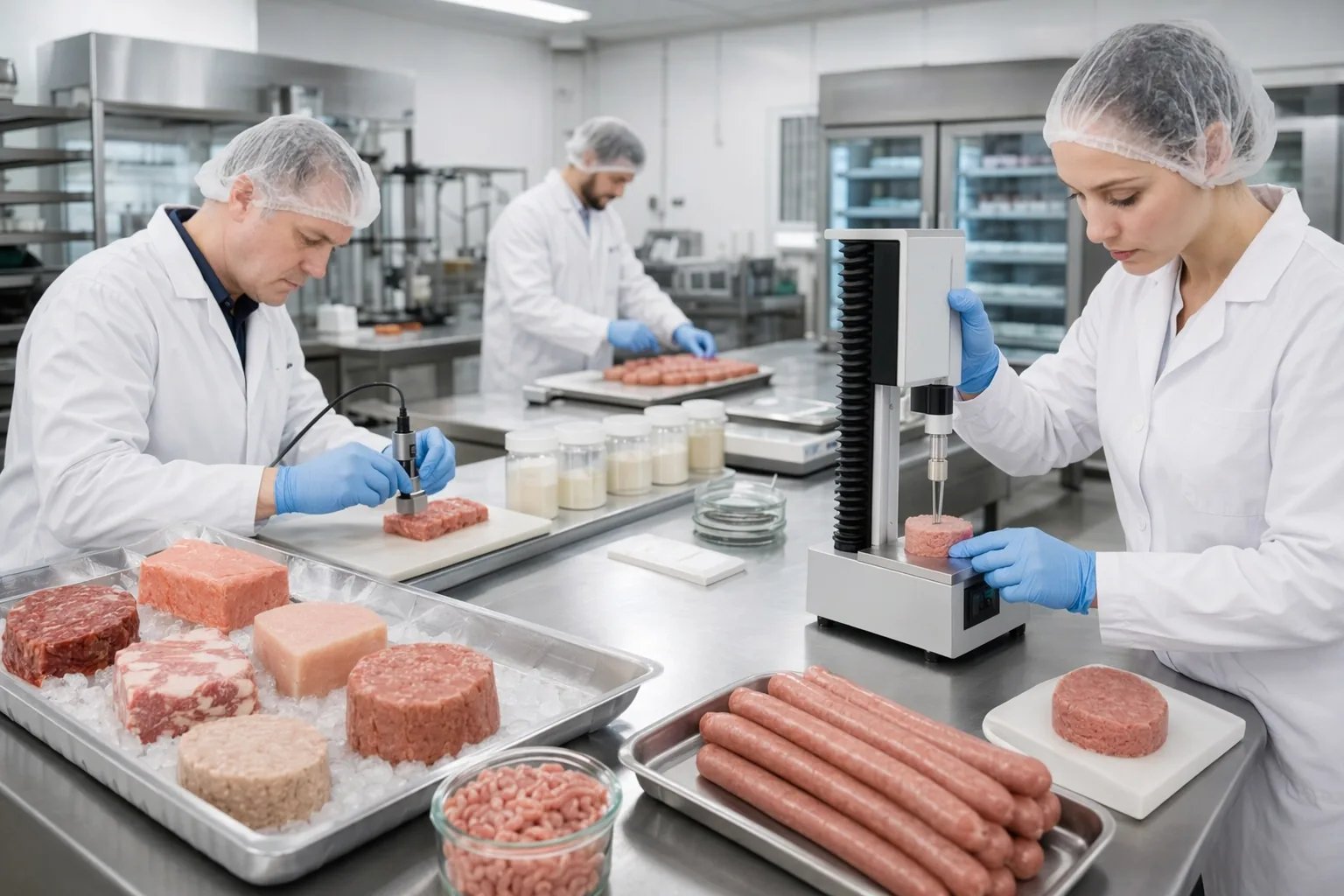
For industrial meat processors, the right enzyme choice is not just activity on a label. Compare binding performance, tenderization control, processing window, documentation, and cost-in-use before approving a supplier.
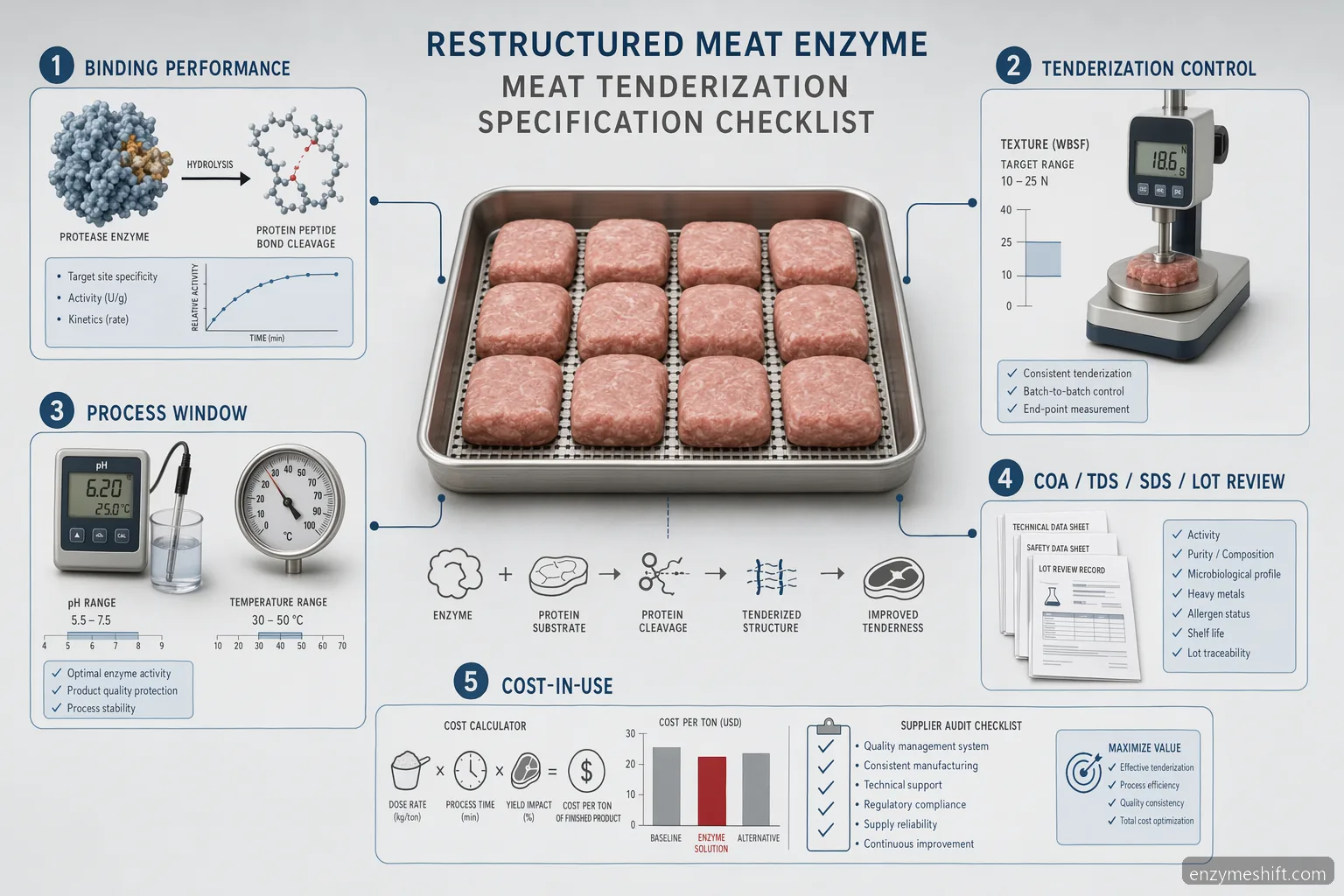
How to Compare Enzymes for Tenderization and Restructuring
A restructured meat enzyme for meat tenderization should be evaluated by function, not by category name alone. Microbial transglutaminase-type systems are commonly used as cold-set binders for restructured meat, portioned steaks, formed products, and some sausage applications because they cross-link proteins and improve slice integrity. Protease-based meat tenderizer enzyme systems act differently: they hydrolyze muscle proteins and connective tissue to reduce bite firmness. In a comparison project, define whether the target is bind strength, tenderness, juiciness, yield, or a combination. Over-tenderization can create pasty texture, purge, or poor bite, while excessive cross-linking can create a rubbery texture. The best specification therefore starts with the finished product target: raw formed product, cooked restructured meat, injected muscle, marinated pieces, or sausage emulsion. Run side-by-side trials using the same meat source, temperature, mixing energy, and hold time so the supplier comparison is meaningful.
Binding target: sliceability, tensile strength, cook yield • Tenderization target: shear force, bite, sensory panel score • Risk check: purge, mushiness, rubbery texture, color shift
Process Conditions to Confirm Before Approval
Industrial restructured meat enzyme meat tenderization trials should use practical processing ranges rather than ideal laboratory conditions. Many binding enzymes perform across roughly pH 5.0 to 8.0, with slower activity at chilled temperatures and faster activity as temperatures rise. For cold-set binder applications, processors often validate 0 to 5°C holding for 4 to 24 hours, depending on formulation, piece size, and enzyme activity. Warm activation steps may shorten time, but must be assessed against microbial control and product quality requirements. Protease tenderizers may be effective at lower dosage and shorter contact times, but they require tighter control because activity can continue until heat inactivation or pH limitation. Typical commercial dosage screening may start around 0.1% to 1.0% for binder preparations and 0.01% to 0.3% for protease preparations, adjusted by declared activity, substrate, and process residence time.
Validate pH in the actual brine, marinade, or meat matrix • Record meat temperature before mixing, holding, and forming • Confirm whether cooking fully stops enzyme action
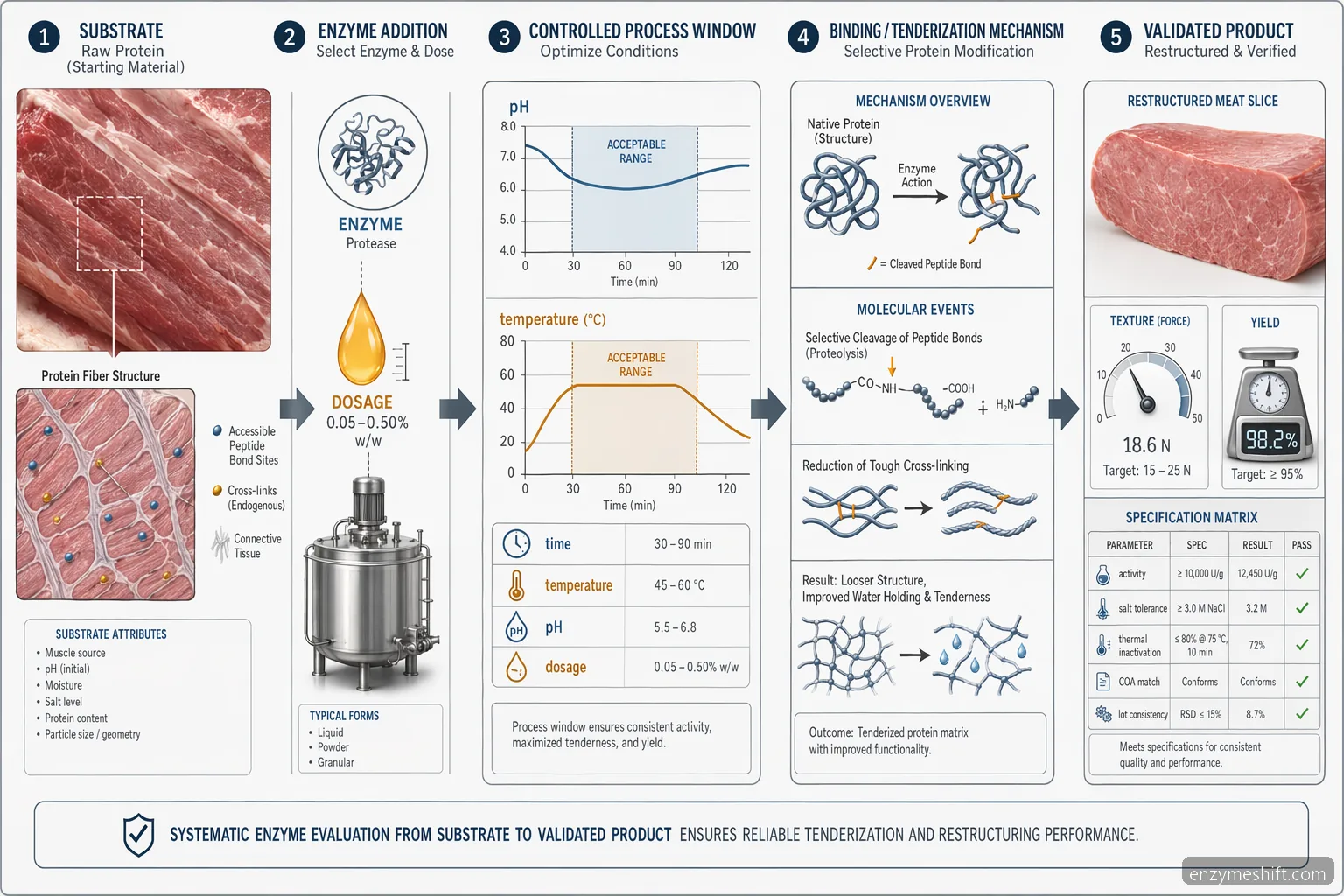
Checklist for COA, TDS, SDS, and Lot Review
A qualified restructured meat enzyme supplier for meat tenderization should provide documentation that supports purchasing, QA, R&D, and regulatory review. The Certificate of Analysis should identify product name, lot number, activity or potency basis, manufacturing date or retest date, and relevant microbiological or compositional results. The Technical Data Sheet should explain recommended applications, dosage guidance, pH and temperature range, storage conditions, shelf life, carrier system, and compatibility limitations. The Safety Data Sheet should cover handling, dust control, personal protective equipment, accidental release, and storage precautions for plant personnel. Buyers should also ask for allergen information, country of origin, ingredient declaration guidance, GMO status where relevant to the market, and lot traceability expectations. Do not rely on marketing claims alone. Supplier data should be matched with incoming QC checks and retained with the plant approval file.
COA: lot-specific activity and quality data • TDS: application range and dosage guidance • SDS: safe handling and storage instructions • Traceability: lot coding and change notification process
Pilot Validation for Meat Tenderization, Sausage, and Restructured Meat
Pilot validation should simulate the commercial process as closely as possible. For restructured meat, evaluate mixing sequence, salt extraction, enzyme dispersion, vacuum tumbling, forming pressure, chilled dwell time, and cook schedule. For sausage, check whether the restructured meat enzyme for sausage affects bind, snap, purge, fat separation, and texture after chilling and reheating. For meat tenderization, measure the effect on standardized muscle cuts using shear force, sensory bite, purge, cook loss, and slice appearance. Always include a control, a low-dose treatment, a target-dose treatment, and an over-dose stress condition. This approach shows the operating window and helps prevent quality failures when raw material variability changes. If the product is marinated or injected, assess enzyme distribution and avoid localized soft spots. Plant trials should also monitor sanitation timing, allergen controls if applicable, and labeling review before commercialization.
Use control, target dose, and overdose trial points • Measure yield, purge, shear force, and texture • Check finished product after storage and reheating
Cost-in-Use and Supplier Qualification
The lowest price per kilogram is rarely the best comparison metric for a meat tenderizer enzyme supplier for restructured meat. Cost-in-use should include dosage required to meet the texture target, yield impact, rework reduction, labor changes, hold-time requirements, and rejected-lot risk. A more concentrated product may cost more per kilogram but reduce dose, storage space, and freight. A cheaper product may require longer dwell time or produce inconsistent texture across meat blocks. Supplier qualification should include sample responsiveness, technical troubleshooting, batch-to-batch consistency, document completeness, change notification, lead time, packaging suitability, and support during scale-up. Buyers should verify current food-grade suitability and any market-specific documentation rather than assuming certifications from a product listing. For ongoing procurement, define acceptance criteria in the specification, including activity range, storage temperature, shelf life on receipt, and corrective action expectations.
Compare cost per treated metric ton, not only enzyme price • Include yield, labor, dwell time, and waste in the calculation • Require documented change notification for formulation changes
Technical Buying Checklist
Buyer Questions
Not always. A restructured meat enzyme is often selected for binding, sliceability, and texture formation, while a meat tenderizer enzyme is commonly protease-based and reduces toughness by hydrolyzing proteins. Some projects need both effects, but they should be validated separately. The safest comparison is to define the product target, run controlled trials, and measure bind strength, shear force, purge, and sensory bite.
Dosage depends on declared activity, carrier system, meat type, formulation, and dwell time. As a practical screening band, many processors test commercial binder preparations around 0.1% to 1.0% and protease tenderizers around 0.01% to 0.3%. These are starting points only. Always confirm with the supplier TDS and run pilot trials under your actual pH, temperature, salt, and processing conditions.
Sometimes, but the performance target is different. A restructured meat enzyme supplier for sausage should demonstrate effects on bind, snap, purge, fat separation, and texture after cooking and chilling. In restructured meat, the same system may be judged by slice integrity, formed shape, and yield. Sausage formulations also include fat, spices, curing ingredients, and emulsification variables that can change enzyme performance.
At minimum, request a lot-specific COA, current TDS, SDS, allergen statement, origin information, shelf-life data, storage guidance, and ingredient declaration support for your target market. The COA should show activity or potency basis and relevant quality results. The TDS should provide dosage and processing guidance. Buyers should also confirm traceability, change notification procedures, and technical support for plant trials.
Cost-in-use should be calculated per treated metric ton or per finished kilogram, not only by enzyme price. Include dosage, enzyme concentration, yield change, purge reduction, dwell time, labor, rework, rejected-lot risk, and freight or storage impact. A higher-priced enzyme may be more economical if it performs at a lower dose, shortens processing time, or provides more consistent texture across variable raw material.
Related Search Themes
restructured meat enzyme supplier for meat tenderization, industrial restructured meat enzyme meat tenderization, restructured meat enzyme supplier for sausage, restructured meat enzyme supplier for restructured meat, restructured meat enzyme for sausage, restructured meat enzyme for restructured meat
Meat Processing Enzymes for Research & Industry
Need Meat Processing Enzymes for your lab or production process?
ISO 9001 certified · Food-grade & research-grade · Ships to 80+ countries
Frequently Asked Questions
Is a restructured meat enzyme the same as a meat tenderizer enzyme?
Not always. A restructured meat enzyme is often selected for binding, sliceability, and texture formation, while a meat tenderizer enzyme is commonly protease-based and reduces toughness by hydrolyzing proteins. Some projects need both effects, but they should be validated separately. The safest comparison is to define the product target, run controlled trials, and measure bind strength, shear force, purge, and sensory bite.
What dosage should an industrial processor test first?
Dosage depends on declared activity, carrier system, meat type, formulation, and dwell time. As a practical screening band, many processors test commercial binder preparations around 0.1% to 1.0% and protease tenderizers around 0.01% to 0.3%. These are starting points only. Always confirm with the supplier TDS and run pilot trials under your actual pH, temperature, salt, and processing conditions.
Can the same enzyme be used for sausage and restructured meat?
Sometimes, but the performance target is different. A restructured meat enzyme supplier for sausage should demonstrate effects on bind, snap, purge, fat separation, and texture after cooking and chilling. In restructured meat, the same system may be judged by slice integrity, formed shape, and yield. Sausage formulations also include fat, spices, curing ingredients, and emulsification variables that can change enzyme performance.
What documents should buyers request from a supplier?
At minimum, request a lot-specific COA, current TDS, SDS, allergen statement, origin information, shelf-life data, storage guidance, and ingredient declaration support for your target market. The COA should show activity or potency basis and relevant quality results. The TDS should provide dosage and processing guidance. Buyers should also confirm traceability, change notification procedures, and technical support for plant trials.
How should cost-in-use be calculated for meat processing enzymes?
Cost-in-use should be calculated per treated metric ton or per finished kilogram, not only by enzyme price. Include dosage, enzyme concentration, yield change, purge reduction, dwell time, labor, rework, rejected-lot risk, and freight or storage impact. A higher-priced enzyme may be more economical if it performs at a lower dose, shortens processing time, or provides more consistent texture across variable raw material.
Related: Meat Processing Enzymes for Controlled Processing
Turn This Guide Into a Supplier Brief Request a technical comparison brief and pilot-sample plan for your meat processing line. See our application page for Meat Processing Enzymes for Controlled Processing at /applications/meat-processing-enzymes/ for specs, MOQ, and a free 50 g sample.
Contact Us to Contributehello@mail.enzymeshift.com