Meat Processing Enzymes Supplier for Meat Tenderization: Specification Checklist
Compare meat processing enzymes for meat tenderization: specs, process conditions, QC, COA/TDS/SDS, pilot trials, cost-in-use, and supplier checks.
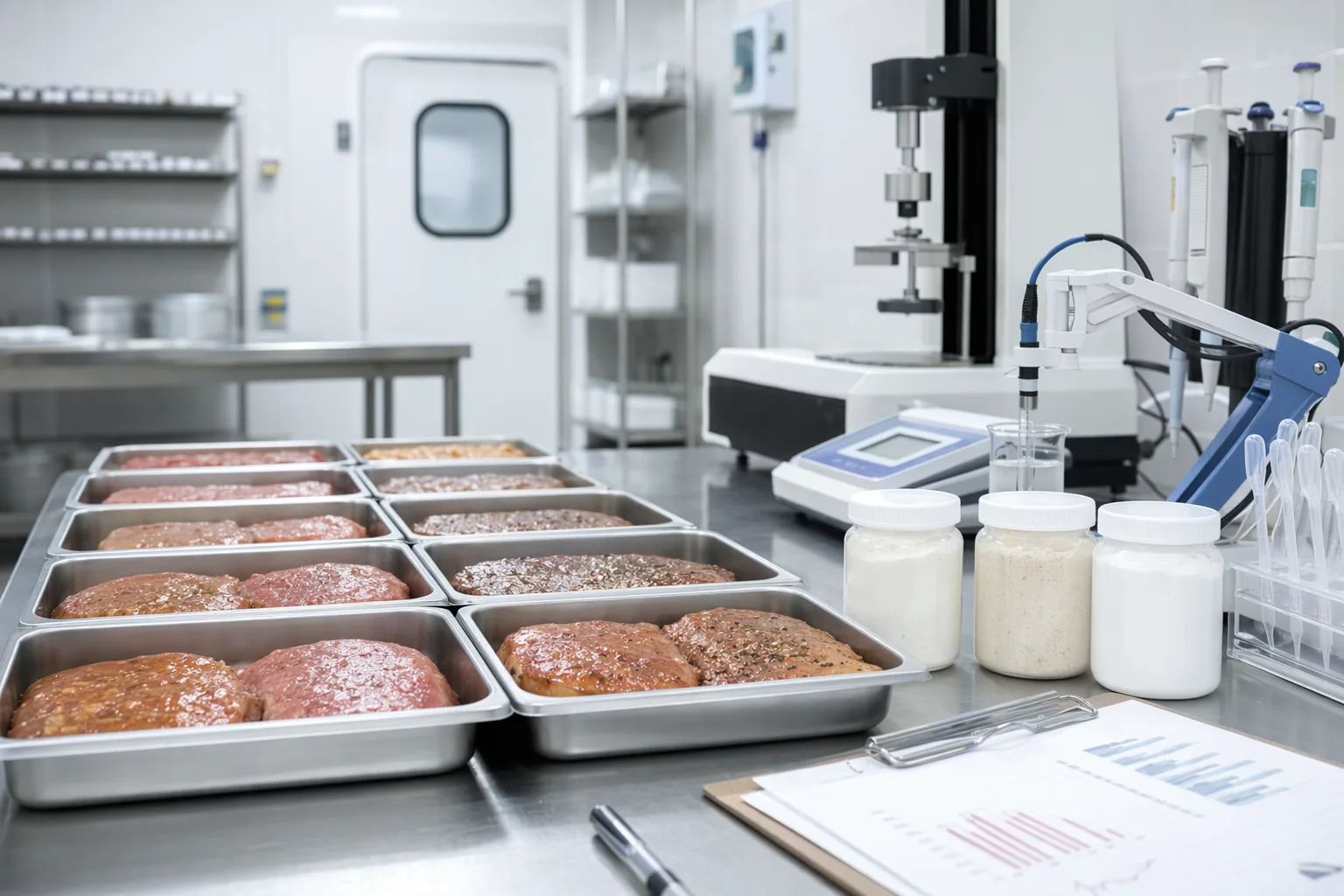
Use this buyer-focused checklist to compare meat processing enzymes, validate tenderization performance, and qualify a supplier before scale-up.
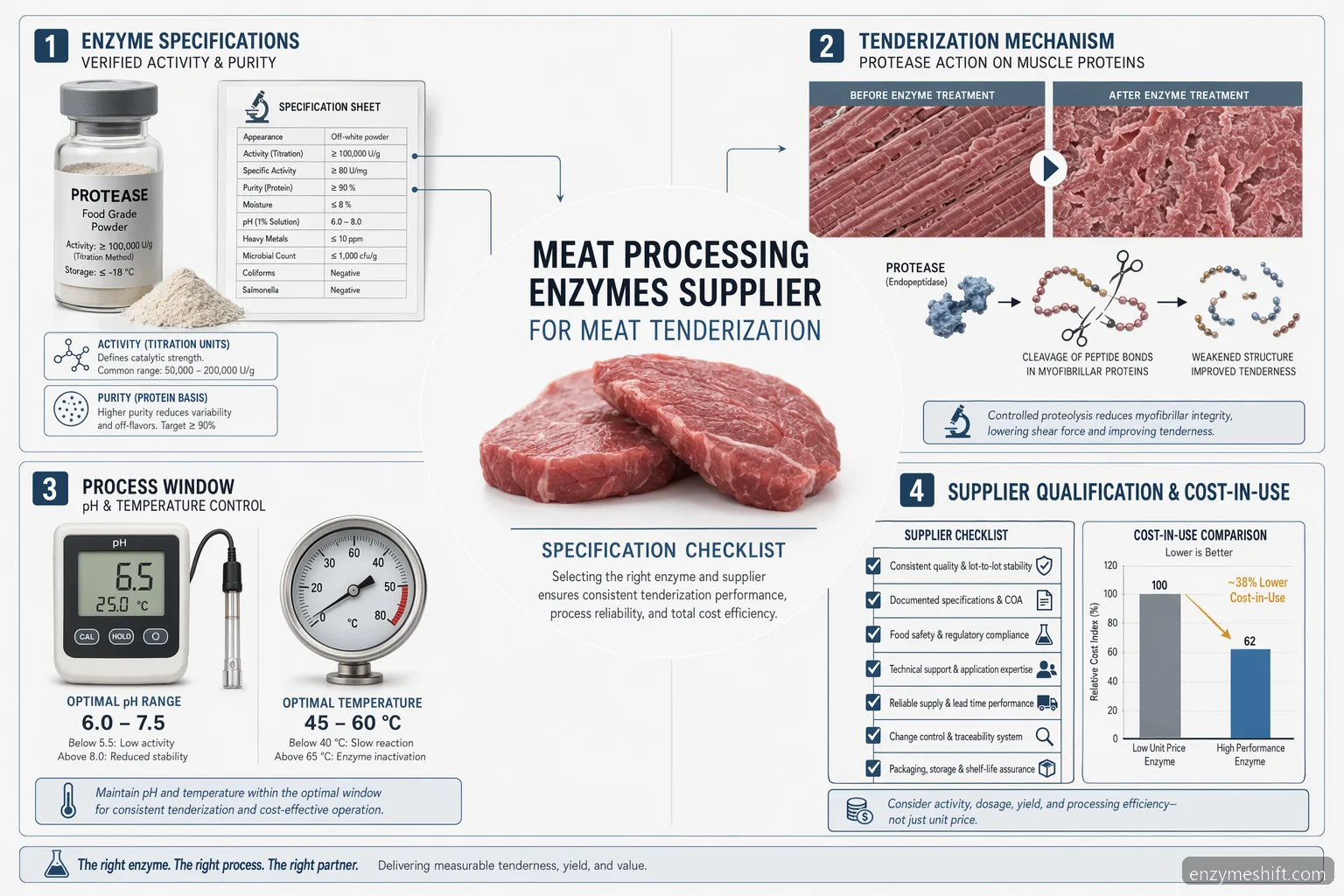
How to Compare Enzymes for Tenderization
A meat processing enzymes supplier for meat tenderization should help match enzyme chemistry to the raw material, not simply quote a price per kilogram. Tenderizing systems are usually proteases that partially hydrolyze myofibrillar and connective tissue proteins. Common commercial choices include plant-derived, microbial, or animal-derived proteases, each with different activity profiles, flavor risk, and label considerations. For beef, pork, poultry, or mechanically tenderized cuts, the buyer should compare enzyme activity at the actual meat pH, typically around pH 5.5 to 6.3, and at the planned process temperature. Cold marination at 0 to 4°C slows activity, while warm activation steps can accelerate hydrolysis. The best option is the enzyme that reaches the target tenderness without mushy texture, excessive purge, or reduced sliceability after cooking.
Compare activity at real meat pH, not only laboratory optimum pH. • Check whether the enzyme can be reliably inactivated by the cooking process. • Evaluate texture, yield, purge, and sensory impact together.
Documentation to Request Before Quotation
For B2B procurement, documentation is part of the specification. Request a current Certificate of Analysis, Technical Data Sheet, and Safety Data Sheet for every enzyme grade under evaluation. The COA should state enzyme activity, test method or unit definition, appearance, moisture or loss on drying where relevant, microbiological limits, and batch number. The TDS should describe composition, carrier or diluent, solubility, recommended pH and temperature range, dosage guidance, storage conditions, shelf life, and handling precautions. The SDS should support plant safety review for dust exposure, respiratory sensitization risk, and personal protective equipment. If comparing meat processing enzymes for meat tenderization across suppliers, reject vague specifications such as “high activity” without a reproducible assay. Clear documentation reduces formulation drift and supports consistent receiving inspection.
Require COA, TDS, SDS, and declared activity units. • Confirm storage temperature, shelf life, and packaging integrity. • Ask for allergen, GMO, origin, and regulatory statements where applicable.
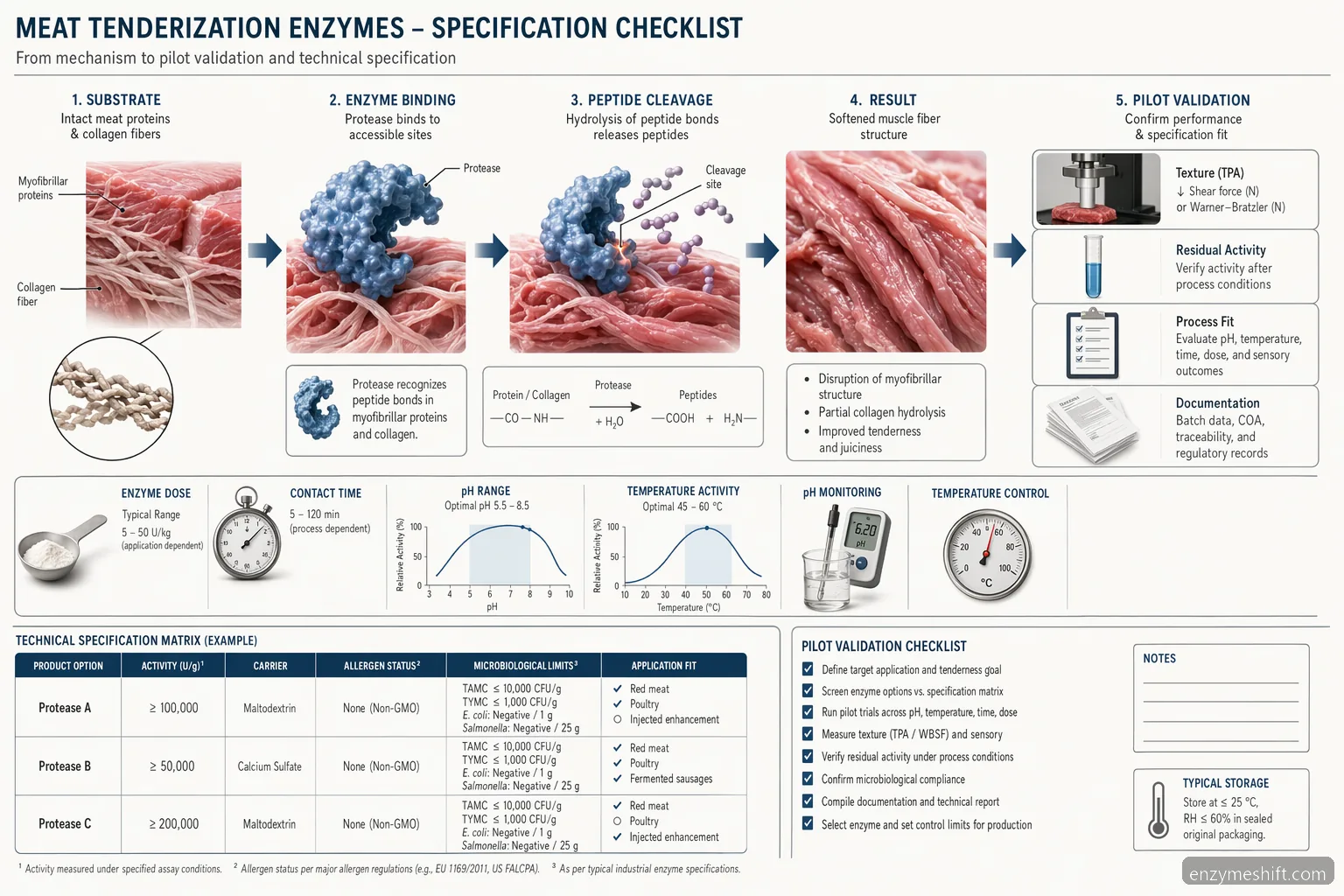
Process Conditions and Pilot Validation
Industrial meat processing enzymes meat tenderization trials should be designed around the actual process route: injection, tumbling, vacuum marination, surface application, or blended marinade addition. Typical starting dosage bands may range from 0.01% to 0.10% enzyme preparation on meat weight, but the correct level depends on enzyme activity, contact time, substrate, particle size, and final heat treatment. Trials often screen pH 5.6 to 6.2, salt-containing brines, 0 to 4°C holding, and any thermal step used for cooking or inactivation. Quality control should include raw pick-up, purge after holding, cook yield, sliceability, texture profile, Warner-Bratzler or similar shear testing, and trained sensory review. Pilot validation should also confirm no over-tenderization during refrigerated distribution. A supplier should help build a trial matrix rather than recommend a single universal dose.
Start with small dose ladders and fixed contact times. • Measure tenderness and yield, not tenderness alone. • Confirm performance after the full chilled holding period.
Tenderization, Sausage, and Restructured Meat Are Different
Buyers often compare a meat processing enzymes supplier for sausage with a meat processing enzymes supplier for restructured meat, but the application target may be different from tenderization. Proteases are mainly used to improve tenderness by controlled protein hydrolysis. In contrast, restructured meat systems may use a cold-set binder such as transglutaminase to support binding between meat pieces or particles. Sausage applications may focus on texture, protein functionality, flavor development, or process efficiency depending on the formulation. A tenderizer enzyme that works well in whole-muscle meat may damage bite or water retention if used incorrectly in comminuted products. For restructured meat, evaluate bind strength, slice integrity, purge, and cook yield. For sausage, evaluate emulsion stability, texture, casing performance, and flavor. The role of enzymes in meat processing depends on the product architecture, not only the protein source.
Proteases tenderize; binders support structure. • Whole-muscle trials do not replace sausage or restructured meat trials. • Define the target attribute before selecting the enzyme.
Supplier Qualification and Cost-in-Use
The lowest quoted price is not always the lowest cost-in-use. Compare suppliers by enzyme activity per delivered kilogram, required dosage, yield impact, rework risk, documentation quality, technical service, batch consistency, lead time, and minimum order quantity. A qualified supplier should provide representative samples, lot-specific COA, stable specifications, change notification practices, and support for scale-up from bench to pilot to production. Ask how activity is controlled between lots and whether the supplier can help troubleshoot pH, salt, phosphate, temperature, and contact-time interactions. For internal training materials such as a role of enzymes in meat processing PPT or role of enzymes in meat processing PDF, base content on validated plant data and supplier documentation rather than generic claims. Procurement, R&D, QA, and operations should approve the enzyme together before commercial adoption.
Calculate cost per metric ton of finished meat, not price per kilogram of enzyme. • Include yield, defects, labor, and rejected-lot risk in the comparison. • Require pilot validation before full-scale purchase commitments.
Technical Buying Checklist
Buyer Questions
Ask for a COA, TDS, SDS, declared activity method, dosage range, recommended pH and temperature conditions, inactivation guidance, and sample availability. Also ask for application support for your specific meat type, process route, contact time, and cooking step. A capable supplier should support pilot validation and help calculate cost-in-use, not only provide a catalog description.
Many pilot trials start with low dose ladders, often around 0.01% to 0.10% enzyme preparation on meat weight, depending on activity and contact time. This is not a universal specification. The right dose depends on meat pH, temperature, marinade composition, raw material variation, distribution time, and the target bite. Always validate using texture, yield, purge, and sensory checks.
Not usually. Tenderizing enzymes are commonly proteases that hydrolyze proteins to soften texture. Restructured meat may use a cold-set binder enzyme, such as a transglutaminase-type system, to support binding between meat pieces. Using a tenderizer where binding is needed can weaken structure. Compare products by application: tenderness, bind strength, sliceability, purge control, and cook yield.
In sausage, enzymes can influence texture, protein functionality, flavor development, or processing behavior, depending on the enzyme and formulation. A meat processing enzymes supplier for sausage should consider comminution, salt level, fat content, casing type, cook schedule, and emulsion stability. Tenderization data from whole muscle products should not be assumed to predict sausage performance without a dedicated pilot trial.
Training files such as a role of enzymes in meat processing PDF or PPT can explain mechanisms, but they should not replace technical qualification. For purchasing decisions, rely on lot-specific COA data, TDS guidance, SDS safety review, supplier questionnaires, pilot trials, and plant QC results. Generic education material rarely captures your exact pH, temperature, brine, contact time, and finished-product requirements.
Related Search Themes
meat processing enzymes supplier for sausage, meat processing enzymes supplier for restructured meat, meat processing enzymes for meat tenderization, industrial meat processing enzymes meat tenderization, enzymes in meat processing, meat processing enzymes
Meat Processing Enzymes for Research & Industry
Need Meat Processing Enzymes for your lab or production process?
ISO 9001 certified · Food-grade & research-grade · Ships to 80+ countries
Frequently Asked Questions
What should I ask a meat processing enzymes supplier for meat tenderization?
Ask for a COA, TDS, SDS, declared activity method, dosage range, recommended pH and temperature conditions, inactivation guidance, and sample availability. Also ask for application support for your specific meat type, process route, contact time, and cooking step. A capable supplier should support pilot validation and help calculate cost-in-use, not only provide a catalog description.
What dosage is typical for meat tenderizer enzyme trials?
Many pilot trials start with low dose ladders, often around 0.01% to 0.10% enzyme preparation on meat weight, depending on activity and contact time. This is not a universal specification. The right dose depends on meat pH, temperature, marinade composition, raw material variation, distribution time, and the target bite. Always validate using texture, yield, purge, and sensory checks.
Are enzymes for restructured meat the same as tenderizing enzymes?
Not usually. Tenderizing enzymes are commonly proteases that hydrolyze proteins to soften texture. Restructured meat may use a cold-set binder enzyme, such as a transglutaminase-type system, to support binding between meat pieces. Using a tenderizer where binding is needed can weaken structure. Compare products by application: tenderness, bind strength, sliceability, purge control, and cook yield.
How do enzymes in meat processing affect sausage quality?
In sausage, enzymes can influence texture, protein functionality, flavor development, or processing behavior, depending on the enzyme and formulation. A meat processing enzymes supplier for sausage should consider comminution, salt level, fat content, casing type, cook schedule, and emulsion stability. Tenderization data from whole muscle products should not be assumed to predict sausage performance without a dedicated pilot trial.
Can I use a role of enzymes in meat processing PDF or PPT for supplier selection?
Training files such as a role of enzymes in meat processing PDF or PPT can explain mechanisms, but they should not replace technical qualification. For purchasing decisions, rely on lot-specific COA data, TDS guidance, SDS safety review, supplier questionnaires, pilot trials, and plant QC results. Generic education material rarely captures your exact pH, temperature, brine, contact time, and finished-product requirements.
Related: Meat Processing Enzymes for Controlled Processing
Turn This Guide Into a Supplier Brief Request samples, documentation, and pilot-trial support for your meat tenderization process. See our application page for Meat Processing Enzymes for Controlled Processing at /applications/meat-processing-enzymes/ for specs, MOQ, and a free 50 g sample.
Contact Us to Contributehello@mail.enzymeshift.com